

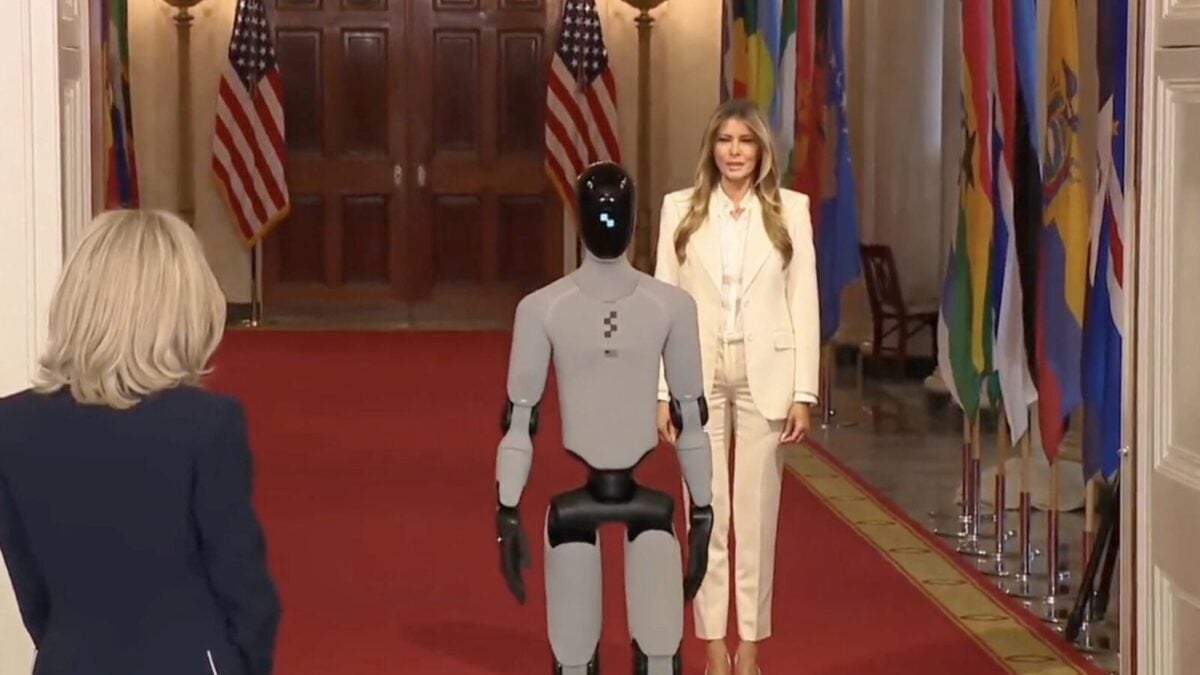
On March 25, 2026, Brett Adcock, the CEO of Figure AI, made a bold claim on X, stating that one of his company’s F.03 concept robots had made history as the "first humanoid robot in the White House." The statement was made during a ceremony for the "Fostering the Future Together" initiative led by First Lady Melania Trump, aimed at promoting technology in education.
The F.03 robot made a brief appearance, thanking the First Lady and welcoming foreign dignitaries in multiple languages before exiting the stage in silence, leading to comparisons with past presidential events involving robots.
However, the question arises: Is this genuinely the first time a humanoid robot has visited the White House? While Adcock's claim may hold some merit, the historical context reveals a more complex narrative.
In 2015, President Barack Obama interacted with a telepresence robot during a meeting with disability advocate Alice Wong. This robot, which resembled a screen on a long neck attached to a Roomba, does not fit the traditional definition of humanoid. Furthermore, Honda's Asimo, a renowned humanoid robot, interacted with Obama during a demonstration at a museum in Tokyo, not the White House.
Similarly, in 2005, President George W. Bush encountered a robot named Albert HUBO at the Asia-Pacific Economic Cooperation summit in South Korea. Albert HUBO featured a lifelike animatronic head of Albert Einstein, but this event also took place outside the White House.
Interestingly, it is suggested that Ronald Reagan might have been the first president to bring a humanoid robot into the White House. In 1987, he received a Tomy Omnibot 2000 during a visit to Purdue University, which was later displayed at the Reagan Presidential Library. However, the Omnibot, which had wheels instead of legs, complicates its classification as a humanoid robot.
To clarify this historical ambiguity, a formal greeting between President Trump and a humanoid robot in the Oval Office could establish a clearer milestone. Such a meeting would mark the first official engagement between a president and a humanoid robot at the White House.
In recent times, President Trump has shown a keen interest in robotics, particularly during a press conference discussing a new battleship project. When questioned about workforce availability, he emphasized the role of robots in future manufacturing, suggesting they could significantly assist the workforce.
Trump's remarks included, "We’re gonna have tremendous workforce availability. We’re also gonna have robots helping us. We’re gonna have a lot of robots helping us because we need it… You can have robots, but you’re gonna have to get somebody to start those robots." This indicates a potential openness to integrating robots into various sectors, including government.
If a humanoid robot were to be employed at the White House to assist the presidential staff, it would represent a significant advancement in the relationship between technology and governance, surpassing the ceremonial nature of the F.03's appearance at the education summit.
As it stands, Brett Adcock’s assertion that the F.03 is the first humanoid robot in the White House remains plausible, given the historical context of robotic interactions in presidential settings. The White House Historical Association has been contacted for further clarification on this matter, and updates may follow based on their insights.
Source: Gizmodo News